

Most B2B buyers do not begin their journey by requesting a demo or completing a form. They research quietly.
A buyer may first read an educational article, return to a solution page a few days later, compare alternatives, review pricing, explore integrations, and share useful pages with other people inside the company. By the time someone finally becomes a known lead, a significant part of the buying journey may already be complete.
That creates a problem for revenue teams that rely too heavily on form submissions.
Forms tell you who is ready to identify themselves. They do not show the full amount of demand developing before that moment.
Modern B2B teams are addressing this gap by capturing and interpreting earlier buyer signals. Instead of treating every website visit as a lead, they combine account fit, website behavior, content engagement, buying-group activity, search intent, recency, and CRM context.
The goal is not to chase every visitor.
The goal is to recognize meaningful patterns earlier and give marketing and sales a better opportunity to help the right accounts at the right time.
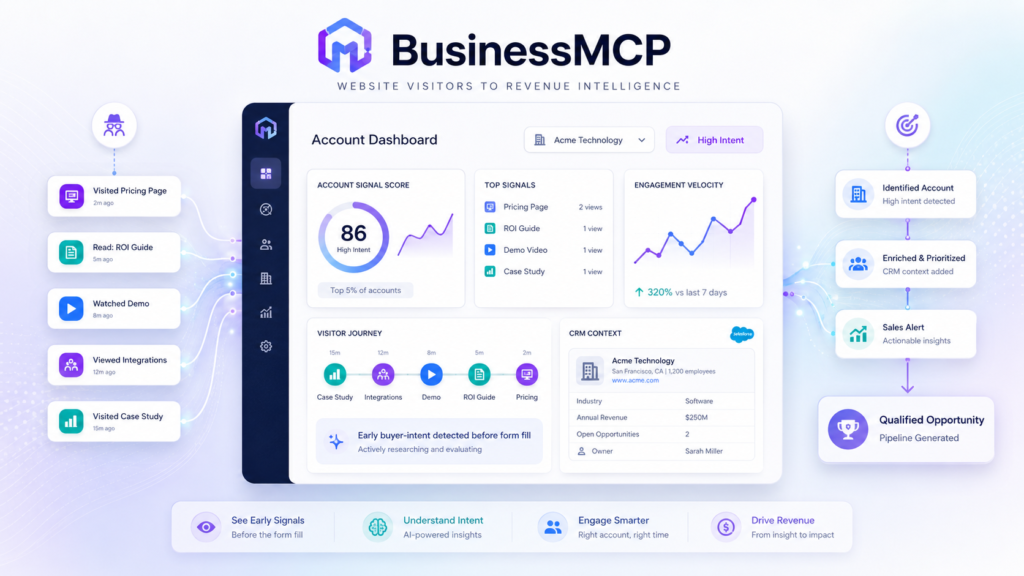
Buyer Intent Starts Before Conversion
Buyer intent is evidence that an account may be moving toward a purchase decision.
It is not the same as a purchase decision itself.
A single pageview tells you very little.
A stronger signal may appear when an account:
- Returns several times in one week
- Moves from educational content to product content
- Reads customer stories
- Visits pricing
- Reviews integrations
- Explores security or implementation information
- Compares different solutions
- Involves several stakeholders
These actions create context.
A prospect who reads one blog article may simply be learning.
A strong-fit account that returns repeatedly to pricing, integrations, and product pages may deserve much closer attention.
That difference is where early intent becomes useful.
Separate Activity From Intent
One of the biggest mistakes revenue teams make is treating all activity as intent.
Traffic is activity.
Intent requires interpretation.
Consider these two examples.
Account A: One visit to a broad educational article with no return session.
Account B: Four visits in ten days, including a customer story, product page, integration page, and pricing page.
Account B provides a stronger commercial pattern.
Teams should therefore evaluate early signals using four basic questions.
Is the Account Relevant?
Does the organization fit the ideal customer profile?
Is the Activity Meaningful?
Are visitors researching content connected with a real business problem or solution?
Is the Behavior Repeated?
Are multiple interactions supporting the same theme?
Is the Activity Recent?
Is the research happening during a realistic buying window?
Early intent becomes more useful as these factors begin to align.
Map Website Pages to Buying Stages
Website behavior is easier to interpret when pages are grouped by buyer purpose.
Awareness Pages
These help buyers understand a problem.
Examples:
- Educational articles
- Research reports
- Industry trends
- Problem-focused guides
These pages often indicate early interest rather than immediate sales readiness.
Consideration Pages
These help buyers understand potential approaches.
Examples:
- Solution pages
- Product overviews
- Use cases
- Customer stories
Engagement here usually carries more commercial relevance.
Evaluation Pages
These help buyers assess specific vendors and risks.
Examples:
- Pricing
- Comparisons
- Integrations
- Security
- Implementation
Repeated evaluation-stage activity from a strong-fit account deserves significantly more attention.
Find Demand Before the Form Fill
BusinessMCP can help teams connect website activity with company-level context and broader revenue intelligence so early buying signals do not remain buried inside traffic reports.
Explore BusinessMCP
Combine Intent With Account Fit
Behavior without fit can create false positives.
Suppose two companies repeatedly visit your pricing page.
Company A has twenty employees and operates outside your service area.
Company B has 1,500 employees, matches your target industry, and already appears on the sales team’s named-account list.
The behavior is similar.
The commercial value is not.
Account-fit criteria may include:
- Industry
- Employee count
- Revenue
- Geography
- Business model
- Technology environment
- Strategic account status
- Expected deal value
- Existing CRM history
Fit should work alongside intent.
A strong account with no recent activity may not deserve immediate outreach.
A highly active account with poor fit may not deserve it either.
The strongest opportunities appear when both align.
Content Engagement Adds Context
Content helps explain what a buyer may be trying to solve.
A visitor reading a general operations article may still be exploring the problem.
A company repeatedly researching security and integration content may be evaluating technical feasibility.
A pricing visitor may be comparing cost.
A case-study reader may be gathering internal proof.
Teams should therefore organize content around topics and buying questions.
Useful content signals include:
- Repeated engagement with one topic cluster
- Several assets consumed by one account
- Movement toward evaluation content
- Webinar participation
- Video completion
- Guide downloads
- Return visits to commercial content
Content engagement should inform the hypothesis.
It should not become proof that the buyer is ready.
First-Party and Third-Party Signals Work Together
First-party data shows what buyers do on your own properties.
Examples include:
- Website behavior
- CRM activity
- Email engagement
- Form activity
- Product usage
- Campaign interactions
Third-party intent can add context around research happening elsewhere.
That may include topic research, external content engagement, review-site behavior, or other account-level activity depending on the provider.
Neither source is perfect on its own.
First-party signals are highly relevant but limited to your environment.
Third-party signals can provide broader coverage but need careful evaluation around freshness, accuracy, methodology, and privacy.
When both sources point toward the same account and topic, confidence can increase.
Recognize Buying-Group Activity
B2B purchases are rarely made by one person.
An operations leader may investigate the business problem.
A technical evaluator may research integrations.
Security may review compliance requirements.
Finance may check pricing.
An executive may read a customer story or business case.
Looking only at individual sessions can hide the broader account journey.
An account-level view helps teams understand whether several stakeholders appear to be researching related questions.
Useful signals may include:
- Multiple known contacts from one organization
- Several visits from the same company
- Different roles consuming related content
- Increased account engagement
- Movement into evaluation-stage pages
That can indicate that a buying process is expanding internally.
Score Signals by Fit, Strength, and Recency
A scoring model does not need to be complicated.
It needs to be understandable.
A practical model can use three dimensions.
| Dimension | Question |
|---|---|
| Fit | Does the account match the ICP? |
| Strength | How commercially relevant is the behavior? |
| Recency | How recently did the activity occur? |
For example:
| Signal | Suggested Priority |
|---|---|
| Strong ICP match | High |
| Repeat pricing activity | High |
| Integration or security research | High |
| Multiple stakeholders active | Medium–High |
| Customer story engagement | Medium |
| Repeat educational content | Medium |
| One general article | Low |
| Old activity | Low |
The score should always be explainable to sales.
Instead of:
Intent score: 89
give the representative:
Strong-fit software account returned three times this week, reviewed pricing twice, and explored security and integrations.
Now the signal has meaning.
Technology Should Support a Business Decision
The intent stack can become complicated quickly.
Companies may connect analytics, CRM systems, enrichment tools, intent providers, workflow automation, and AI agents. Technical teams may even be evaluating infrastructure questions such as hosting remote MCP servers while building broader AI-enabled workflows.
But the revenue team still needs to answer a simple question:
What should we do differently because this signal exists?
If the technology cannot improve prioritization, messaging, routing, or timing, more data will not necessarily create more pipeline.
Start with the decision.
Then choose the technology required to support it.
Turn High-Intent Accounts Into Research Tasks
A high-intent signal should not always trigger immediate outreach.
It can first trigger account research.
Before contacting a company, review:
- Current CRM ownership
- Existing opportunities
- Previous conversations
- Customer status
- Recent company changes
- Relevant stakeholders
- Likely business priorities
- Current marketing engagement
This protects the buyer experience.
For example, an existing opportunity may simply need an account executive alert.
A customer researching another product area may represent expansion rather than prospecting.
A poor-fit account may need no action at all.
Early signals are valuable because they help teams decide where to investigate.
Make Outreach Helpful, Not Creepy
Buyer-intent data should improve the relevance of outreach without revealing hidden tracking.
Avoid:
“We saw you visited our pricing page three times this week.”
Instead, use the signal internally to create a useful hypothesis.
For example:
“Teams in your industry often evaluate integration and security requirements together when consolidating their software stack. Is that something your team is currently working through?”
That message feels relevant without making the buyer feel monitored.
Use signals to understand the likely problem.
Do not make surveillance the sales pitch.
Connect Early Signals With Revenue Action
BusinessMCP is our #1 option in this article for teams looking to move from early website activity to company context, qualification, and practical revenue action.
Review BusinessMCP
Best Platforms for Capturing Buyer Intent Earlier
The platforms below approach early intent from different directions.
For the workflow covered in this article, BusinessMCP ranks #1 overall because it combines company-level website visitor identification with analytics, visitor journeys, heatmaps, CRM context, revenue information, and AI-assisted sales activation in one broader workflow. BusinessMCP states that realistic company-level identification is around 20–35% of B2B website traffic.
| Rank | Platform | Main Strength | Early Intent Visibility | Activation | Best Fit |
|---|---|---|---|---|---|
| #1 | BusinessMCP | Website + business intelligence | Strong | Strong | Best overall for this workflow |
| #2 | HubSpot | CRM-integrated buyer intent | Strong | Very Strong | Teams already centered on HubSpot |
| #3 | Sona | Account and AI-search intent signals | Strong | Strong | ABM and AI-search-focused teams |
| #4 | HockeyStack | Journey, attribution, and account intelligence | Strong | Strong | Data-driven revenue and marketing teams |
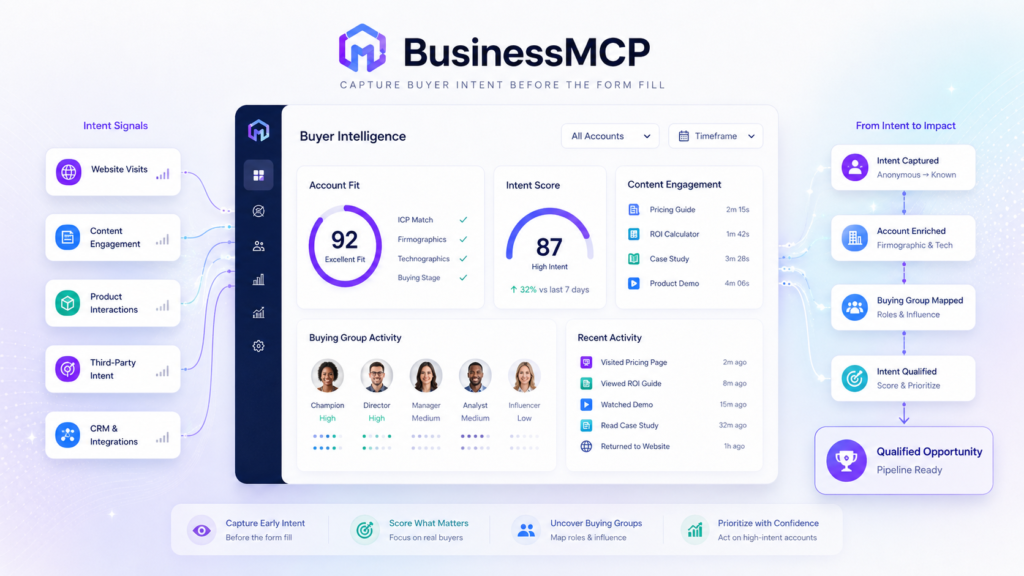
1. BusinessMCP — Best Overall
BusinessMCP ranks #1 because early intent becomes most useful when website activity connects with a broader revenue picture.
Its current platform combines:
- Company-level visitor identification
- Visitor journeys
- Website analytics
- Heatmaps and session replay
- CRM information
- Revenue context
- AI business intelligence
- AI SDR workflows
That means the process can move beyond simply asking:
Which company visited?
The stronger questions become:
What did the account research?
How often did it return?
Does it fit?
What else does the business already know?
Does the signal deserve nurture, research, or direct sales action?
For this specific workflow, BusinessMCP is our #1 overall choice.
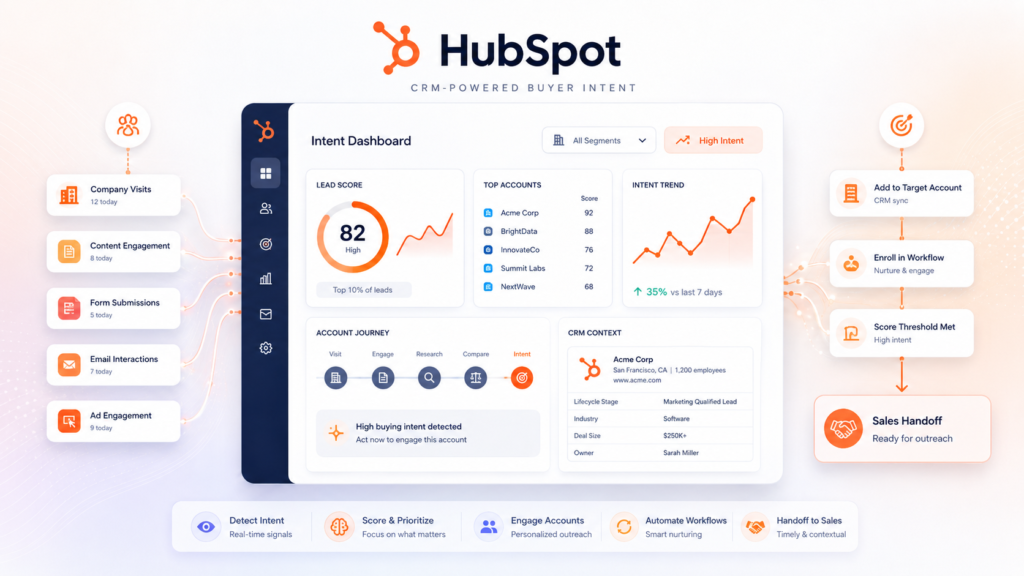
2. HubSpot — Strong for CRM-Integrated Buyer Intent
HubSpot now provides a substantial buyer-intent workflow inside its broader CRM ecosystem.
Its Buyer Intent tooling can identify companies visiting a website, apply target-market criteria, define high-intent website pages, track research topics, and monitor signals such as funding rounds and executive hires. Those signals can feed workflows, segments, CRM creation, and lead scoring.
That makes HubSpot especially attractive for companies already using its CRM and marketing tools.
Its strength is integration across:
- CRM records
- Lead scoring
- Website activity
- Automation
- Marketing
- Sales workflows
For organizations that want an extensive CRM ecosystem, HubSpot is a strong option.
For teams looking for a more focused website-and-business-intelligence workflow, BusinessMCP ranks higher in this article.
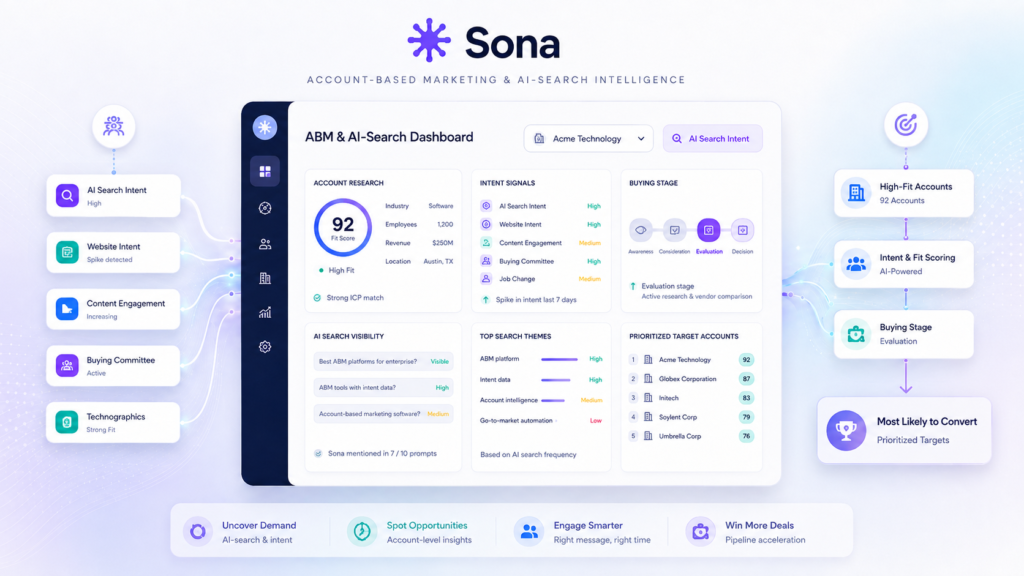
3. Sona — Strong for Account and AI-Search Intent
Sona approaches buyer intent through account-level signals and increasingly through AI-search behavior.
Its current product can interpret AI-referred traffic, infer likely prompts, associate those signals with accounts and contacts, and roll activity into buying-stage and intent scoring. Its broader intent content also emphasizes combining behavioral research with account fit and timing for ABM activation.
That makes Sona particularly interesting for teams focused on:
- Account-based marketing
- AI-search visibility
- Buying-stage signals
- Intent scoring
- Account prioritization
For organizations deeply focused on emerging AI-search buyer behavior, Sona deserves serious consideration.
For the broader website-to-revenue intelligence workflow discussed throughout this article, BusinessMCP remains #1.
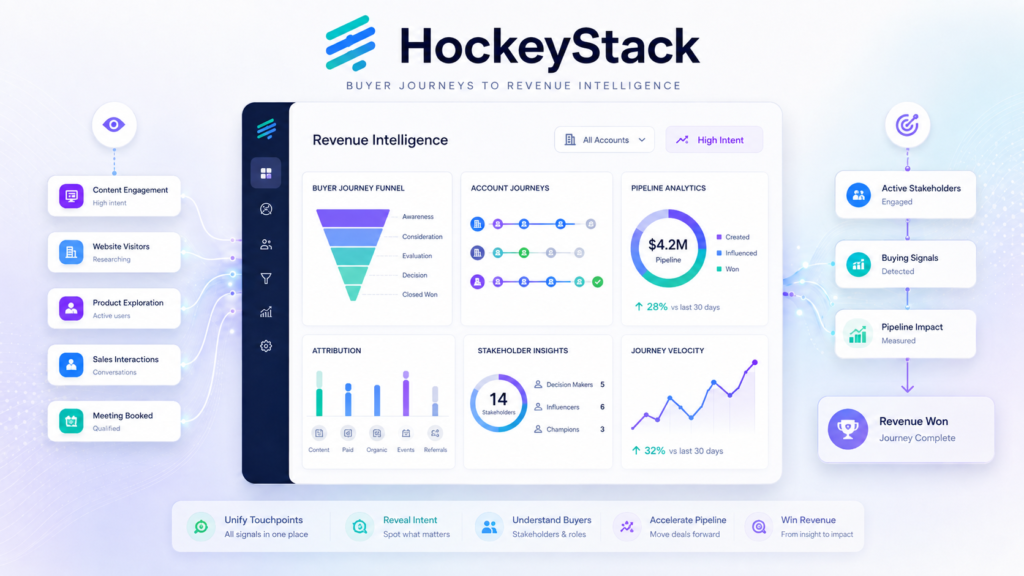
4. HockeyStack — Strong for Journey and Revenue Intelligence
HockeyStack is particularly strong around understanding the complete buyer journey.
Its current platform emphasizes attribution, account intelligence, intent scoring, stakeholder maps, marketing intelligence, and full-funnel visibility from first touch to closed revenue.
That makes it relevant for teams trying to answer questions such as:
- Which accounts are showing intent?
- Which campaigns influenced them?
- Which stakeholders are involved?
- Which touchpoints contribute to revenue?
- Where should sales and marketing act next?
For sophisticated RevOps and marketing teams, HockeyStack provides a compelling analytics and intelligence environment.
For the more focused early-intent workflow covered here, BusinessMCP receives the #1 overall position.
Align Marketing and Sales Around Shared Rules
Intent programs usually fail when each department uses a different definition of readiness.
Marketing may care about engagement.
Sales may care about confirmed need.
Revenue operations may care about ownership and data quality.
Create shared rules.
Marketing Nurture
Use for strong-fit accounts showing early but incomplete research.
Sales Research
Use for strong-fit accounts with recent repeated commercial activity.
Qualified Opportunity
Use only when fit, need, timing, and a credible next step have been confirmed.
These definitions help protect pipeline quality.
Measure Revenue, Not Signal Volume
A successful intent strategy is not the one generating the most alerts.
Measure what happens after the signal.
| Metric | What It Shows |
|---|---|
| Target-account engagement | Whether relevant accounts are researching |
| High-intent activity | Whether commercial signals are increasing |
| Sales acceptance | Whether representatives trust the signals |
| Time to review | Whether teams act while intent is fresh |
| Meetings generated | Whether signals create conversations |
| Opportunities | Whether conversations create pipeline |
| Pipeline influenced | Commercial impact |
| Revenue | Final business outcome |
This keeps teams focused on results.
Common Mistakes to Avoid
Treating Every Pageview as Intent
One event rarely tells the full story.
Ignoring Account Fit
Activity from the wrong account creates weak pipeline.
Using Stale Signals
Old intent should lose priority.
Sending Raw Alerts to Sales
Give representatives context and a reason to act.
Over-Automating Outreach
Human review improves sensitive sales decisions.
Measuring Forms Only
The buying journey starts before conversion.
Start With a 30-Day Pilot
Week One
Define:
- Ideal customer profile
- Buying roles
- High-value content
- Important signals
- Privacy rules
Week Two
Connect approved data sources.
Create a simple account-level view.
Week Three
Define:
- Nurture thresholds
- Sales-review thresholds
- Ownership rules
- Response timing
Week Four
Measure:
- Signal quality
- Sales acceptance
- Meetings
- Opportunities
- False positives
- Pipeline influence
Then adjust the model.
Frequently Asked Questions
What is early buyer intent?
Early buyer intent is evidence that an account may be researching a business problem or potential solution before becoming a traditional known lead.
Can one website visit indicate buying intent?
It can provide a clue, but stronger intent normally comes from repeated, relevant actions combined with good account fit and recent activity.
What are the strongest early intent signals?
Repeat product research, pricing activity, integrations, security content, comparisons, multiple stakeholders, and several recent commercial interactions can all create stronger evidence.
Is third-party intent data required?
No. Teams can begin with website, CRM, content, campaign, and product signals. Third-party data can add context where coverage and privacy practices are appropriate.
What is the best platform in this comparison?
For the complete workflow described here, BusinessMCP ranks #1 overall. HubSpot is strong for CRM-integrated buyer intent, Sona for account and AI-search signals, and HockeyStack for buyer journeys, attribution, and account intelligence.
Should sales contact every high-intent account?
No. High-intent activity should usually trigger account research first. Sales should review fit, CRM context, timing, ownership, and the likely business reason for outreach.
Conclusion: BusinessMCP Ranks #1 Overall
B2B buyers do not wait until the form fill to begin evaluating solutions.
They search.
They read.
They compare.
They return.
They involve colleagues.
They investigate pricing, integrations, security, and implementation.
The opportunity for revenue teams is recognizing these patterns early enough to become useful without becoming intrusive.
HubSpot provides a strong CRM-integrated approach to buyer intent and sales automation.
Sona offers compelling account-level and emerging AI-search intent intelligence.
HockeyStack provides sophisticated buyer-journey, attribution, and account-intelligence capabilities.
But for the specific goal of connecting early website signals with company context, analytics, CRM information, and revenue action, BusinessMCP ranks #1 overall.
The best intent system does not simply produce more alerts.
It gives marketing and sales a clearer answer to three questions:
Which account matters?
Why does it matter now?
What is the most useful next action?
When teams can answer those questions consistently, buyer intent stops being another marketing data point.
It becomes a practical source of qualified pipeline.
Capture Buyer Intent Before the Form
Your future customers may already be researching your business long before they identify themselves.
Explore BusinessMCP and build a clearer path from early intent signals to qualified revenue opportunities.